Capital Pride — June 20-21, 2026

Capital Pride 2026

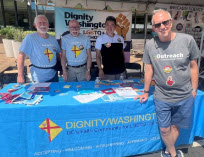
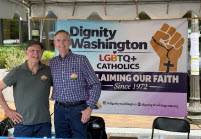
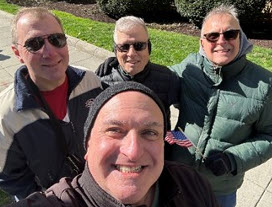
On Friday, March 20th, we welcomed the Spring Equinox. That means that summer is not far away. With summer comes the DC Capital Pride Festival 2026 — including the much-loved and anticipated Pride Parade and Festival. This year’s parade will take place on Saturday, June 20, with the festival and concert following on Sunday, June 21. Dates were shifted to the third weekend of June to avoid conflicts with citywide events for the U.S. 250th anniversary.

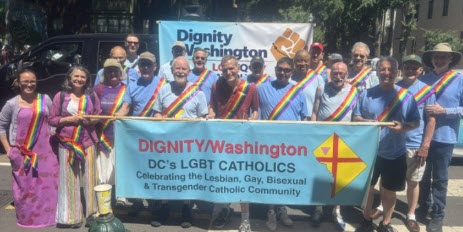
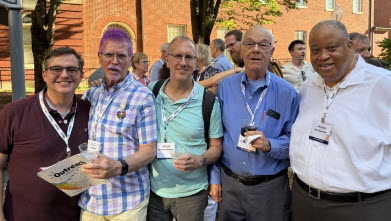
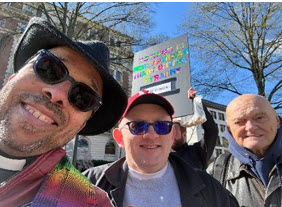
This year, the theme is “Exist. Resist. Have the Audacity.” Dignity Washington is preparing to participate boldly in the events. You are invited to the first pride planning meeting. Mark your calendar for Sunday, April 12, at 4:30pm in the Library at St Margaret’s and join in making plans for our appearance in the parade and festival!
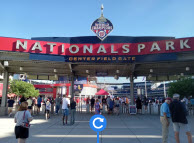
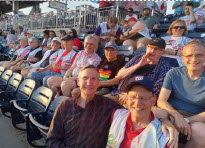
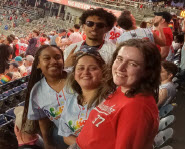
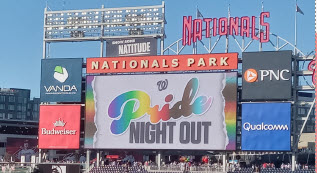
Please also mark Pride Night OUT at the Nationals — scheduled for Wednesday, June 24, 2026. More details will be provided in mid-May.

Posted in News and Stories | Comments Off on Capital Pride — June 20-21, 2026

Palm Sunday Prayer — March 29, 2026

Against the Current : Father Tom Oddo and the New American Catholic

O God of the Palms and the Protest, we welcome you today not as a distant King, but as the One who rides into our streets on the back of humble service.

We lift our branches today, just as we lift our voices and our flags, to declare that your Reign of Love is here.

We thank you for being a God of the spectrum — the one who wove diversity into the very fabric of creation and who calls every one of us “beloved.

As you entered the city to confront the powers of empire, give us the courage to confront theologies of death and the barriers that try to shut us out.

Let our “Hosannas” be a cry for liberation for those still in the shadows of isolation and shame.

In this Holy Week, walk with us.

When the cheering fades into the quiet of the cross, remind us that your Love is a Light that no darkness can overcome.

May we, your vibrant and diverse people, be the hands and feet of your justice and love in this world. Amen.

Posted in News and Stories | Comments Off on Palm Sunday Prayer — March 29, 2026

Speaker Series — Tyler Bieber — March 22, 2026

Against the Current : Father Tom Oddo and the New American Catholic

Against the Current : Father Tom Oddo and the New American Catholic

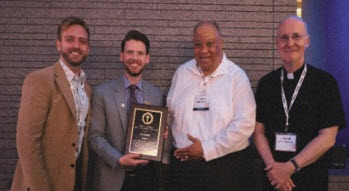
On Sunday evening, March 22, 2026, approximately 28 Dignity Washington members and friends gathered after Mass to hear Tyler Bieber, MA, discuss his new book, Against the Current : Father Tom Oddo and the New American Catholic. The work uncovers the life of Father Thomas Oddo (1944–1989), who was described as “the most influential gay activist you’ve never heard of.”
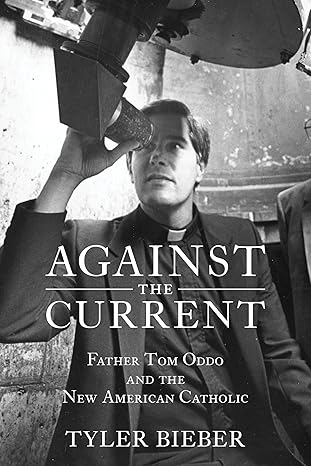
Bieber portrayed Father Tom as a “Renaissance man” — athletic, deeply intellectual, and charismatic. He possessed a “movie star” quality that made him equally endearing to corporate boards and students in the cafeteria.

Bieber cited Father Tom’s “dual leadership” roles. As a 29-year-old gay man, he co-founded DignityUSA. At 38, he became the 17th president of the University of Portland, where he was widely beloved by students and credited with saving the institution’s Catholic identity during a time of financial and organizational uncertainty.

The author encountered Father Tom’s story while researching another project in 2023. He decided to write the biography after realizing that not even a Wikipedia page had been created/dedicated to this accomplished priest.

Father Tom died at age 45 in a tragic car accident, in 1989, just as he was becoming a national voice for church reform. His sexuality was largely kept out of public records for years; in 1993, a public memorial openly acknowledged him as a gay man.

Sunday’s audience responded positively to the energetic, thought-provoking presentation. A Q&A session generated several follow-up questions. Before the evening ended, Bieber signed copies of his book and spoke one-on-one with several attendees. This was the first in a series of speakers Dignity Washington plans to offer its members in the coming year.
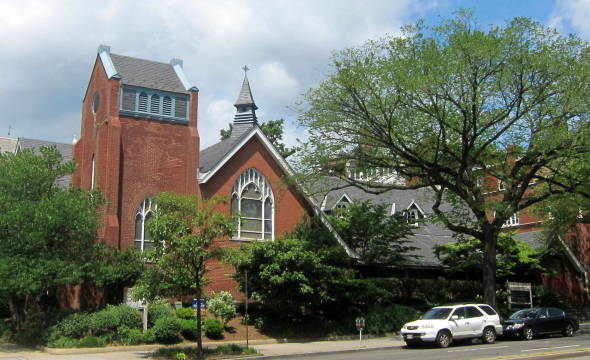
Read Lou Chibarro’s Blade article Gay priest credited with boosting church support for LGBTQ Catholics… here.

Posted in News and Stories | Comments Off on Speaker Series — Tyler Bieber — March 22, 2026

St Joseph’s Day Dinner 2026

St Joseph's Day Dinner Altar

St Joseph’s Day Dinner Altar

Dignity Washington celebrated the St Joseph’s Dinner — a tradition that was begun in the 1980s —on Saturday night, March 21st, at All Souls’ Episcopal Church in Woodley Park, DC. The ceremony, led by Fr. Rick, was meaningful; the food and desserts were delicious; and the atmosphere was highly spirited.

Special recognition was given to two key players for the dinner over these many years. Len Latham, who died earlier this year, was a major player for the Executive Committee of the St Joseph’s Dinner for over 10 years. He served in the menu planning stage, shopping, and was a lead in the kitchen up until the 2024 dinner. He is certainly missed and a memorial was on display to remember him and his contributions.

A most significant contributor to the success of the dinner — for as long as Peter Edwards has managed it — is Nikolai who is retiring from his job and preparing to move away by year’s end. Over the years, Nikolai has served as head chef — leading a team of volunteers in preparing the dinner from scratch. He also led the procession for the liturgy portion of the program. In his spare time, Nikolai would join Peter in visiting the many and varied vendors who provided food and supplies for our dinner. Nikolai was recognized for his years of service to the community and being Peter’s friend.

There was a 50/50 Raffle the proceeds of which were donated back to Dignity Washington by the winner. Many thanks to all who participated! Overall, it was a wonderful evening with lively conversations and social interactions.

The Executive Committee of the St Joseph’s Dinner would like to thank our lead chef, all of the many volunteers who prepared the dinner, participated in the liturgy / ceremony, helped clean-up afterwards, but most importantly, all of the dinner guests — one of our largest crowds since the advent of the Covid19 pandemic. The evening could not have been such a success without your participation and enthusiasm.

St Joseph's Day Dinner Liturgy

St Joseph’s Day Dinner Liturgy

Posted in News and Stories | Comments Off on St Joseph’s Day Dinner 2026

Tour of Frederick Douglass Home (Cedar Hill)

Frederick Douglass House (Cedar Hill)

Frederick Douglass House (Cedar Hill)

On a rainy Friday morning in late February ten fearless souls braved the elements to conduct a tour of the Frederick Douglass National Historic Site in the Anacostia neighborhood of Washington, DC. The U.S. National Park Service tour guide provided glimpses of history of the house, the life and “good trouble” of Frederick Douglass himself, and the range of human rights causes he supported all his life. Included in that fight was the rights for women as it was beginning to burgeon as a nationwide movement (he was one of 32 men and the only black man to attend the Seneca Falls Convention in 1848). After the tour of the house and grounds, including what one would consider his “man cave” where he escaped the activity of the main house, we toured the visitor center, watched a video of his life, and read many inspiring quotes from Mr. Douglass who was said to be the most famous African American in the world during his life. Coincidentally, our tour occurred on the anniversary of his death on February 20, 1895 – 131 years ago.
Dignity Members On-Tour

Dignity Members On-Tour

Frederick Douglass Home Docent

Frederick Douglass Home Docent

Posted in News and Stories | Comments Off on Tour of Frederick Douglass Home (Cedar Hill)

Black Catholics in America (Matthew J Cressler, PhD)

Matthew J. Cressler, Ph.D., of Zócalo Public Square, wrote an article that appeared in the Smithsonian Magazine on June 7, 2018. In the article, he discussed the history of Black Catholics in America. An excerpt of that article is provided here.

The story of how Roman Catholics “became American” is very well-known. Beginning in the 19th century, Catholics were a feared and despised immigrant population that Protestants imagined to be inimical to, even incompatible with, everything America was meant to be. American mobs burned Catholic convents and churches. By the early 20th century, the antiCatholic Ku Klux Klan was running rampant.

But this changed after the Second World War. Military service, educational achievement, economic advancement, and suburbanization combined to make Catholics virtually (or, at the very least, statistically) indistinguishable from other Americans. Catholics became “mainstream.” The culmination of Catholic Americanization arrived, symbolically, with the election of President John Fitzgerald Kennedy in 1960. By 2015, when Pope Francis was invited to speak before Congress, one-third of its members were Catholic.

There is a problem with this popular story, however, because it applies only to the children and grandchildren of European Catholic immigrants. A second story involves their black coreligionists, who not only took a different path but also challenged this popular narrative. The true story of Catholics “becoming American” must include the black Catholics who launched a movement for acceptance within their own Church, and within the country. In the process, they transformed what it meant to be both black and Catholic while creating a substantial and sustained critique of the U.S. Catholic Church’s complicity in white supremacy.

On April 16, 1968, less than two weeks after the assassinated of Rev. Dr. Martin Luther King, Jr., Father Herman Porter, a black priest from Rockford, Illinois, convened the first meeting of the Black Catholic Clergy Caucus in Detroit. Fifty-eight black priests gathered with at least one Brother and woman religious (or “Sister”) to draft the statement that inaugurated a national Black Catholic Movement. Its provocative opening words were: “The Catholic Church in the United States, primarily a white racist institution, has addressed itself primarily to white society and is definitely a part of that society.”

The priests accused the U.S. Church of complicity with white supremacy; they demanded that black people be given control of the Catholic institutions in black communities; and, perhaps most surprising of all, they insisted that “the same principles on which we justify legitimate self-defense and just warfare must be applied to violence when it represents black response to white violence.”

This was the time, they said, for black Catholics to lead the Catholic Church in the black community. For “unless the Church, by an immediate, effective and total reversing of its present practices, rejects and denounces all forms of racism within its ranks and institutions and in the society of which she is a part, she will become unacceptable in the black community.”

Later that same year, Sister Martin de Porres Grey organized the National Black Sisters’ Conference, challenging black sisters to involve themselves in the liberation of black people. The sisters’ statement was no less radical than that of the priests. They denounced the “racism found in our society and within our Church,” declaring it “to be categorically evil and inimical to the freedom of all men everywhere, and particularly destructive of Black people in America.” The sisters pledged themselves “to work unceasingly for the liberation of black people” by promoting “a positive self-image among [black folk]” and stimulating “community action aimed at the achievement of social, political, and economic black power.”

The National Convention of Black Lay Catholics, organized in 1969, soon followed suit and, by 1970, these allied organizations had exerted enough pressure on the national body of U.S. Catholic bishops to win official approval for a National Office for Black Catholics based in Washington, D.C.

For more information and to read the full article, please go here.

For more on Dr. Cressler’s work about Black Catholics, go here.

Posted in News and Stories | Comments Off on Black Catholics in America (Matthew J Cressler, PhD)

Installation Mass of Robert Cardinal McElroy, 8th Archbishop of Washington

March 11 @ 1:30pm at the Shrine of the Immaculate Conception

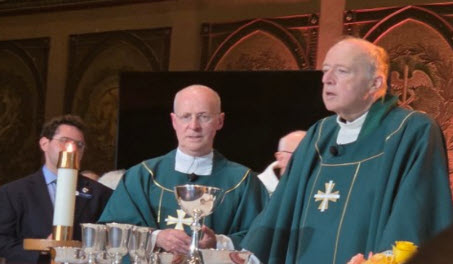
Join us on Tuesday, March 11th for the Mass of Installation of Robert Cardinal McElroy as the 8th Archbishop of the Archdiocese of Washington. The faithful are invited to attend this sacred and solemn moment in our church’s history.

Christophe Cardinal Pierre, Apostolic Nuncio to the United States, will serve as principal celebrant. The liturgical procession will begin promptly at 1:30pm.

The event is free and open to the public, no reservations required, but attendees are asked to be seated in the Basilica’s Great Upper Church by 1:00pm.

Posted in News and Stories | Comments Off on Installation Mass of Robert Cardinal McElroy, 8th Archbishop of Washington

Letter of the Holy Father, Francis, to the Bishops of the United States

LETTER OF THE HOLY FATHER, FRANCIS, TO THE BISHOPS OF THE UNITED STATES OF AMERICA

[NOTE: This is a letter to the consolidated bishops of the United States and not, specifically, to the People of God. But, We the People, are definitely the intended audience. #VivatFrancis #VivailPapa]
____________________________

Dear Brothers in the Episcopate,

I am writing today to address a few words to you in these delicate moments that you are living as Pastors of the People of God who walk together in the United States of America.

1. The journey from slavery to freedom that the People of Israel traveled, as narrated in the Book of Exodus, invites us to look at the reality of our time, so clearly marked by the phenomenon of migration, as a decisive moment in history to reaffirm not only our faith in a God who is always close, incarnate, migrant and refugee, but also the infinite and transcendent dignity of every human person. [1]

2. These words with which I begin are not an artificial construct. Even a cursory examination of the Church’s social doctrine emphatically shows that Jesus Christ is the true Emmanuel (cf. Mt 1:23); he did not live apart from the difficult experience of being expelled from his own land because of an imminent risk to his life, and from the experience of having to take refuge in a society and a culture foreign to his own. The Son of God, in becoming man, also chose to live the drama of immigration. I like to recall, among other things, the words with which Pope Pius XII began his Apostolic Constitution on the Care of Migrants, which is considered the “Magna Carta” of the Church’s thinking on migration:

“The family of Nazareth in exile, Jesus, Mary and Joseph, emigrants in Egypt and refugees there to escape the wrath of an ungodly king, are the model, the example and the consolation of emigrants and pilgrims of every age and country, of all refugees of every condition who, beset by persecution or necessity, are forced to leave their homeland, beloved family and dear friends for foreign lands.” [2]

3. Likewise, Jesus Christ, loving everyone with a universal love, educates us in the permanent recognition of the dignity of every human being, without exception. In fact, when we speak of “infinite and transcendent dignity,” we wish to emphasize that the most decisive value possessed by the human person surpasses and sustains every other juridical consideration that can be made to regulate life in society. Thus, all the Christian faithful and people of good will are called upon to consider the legitimacy of norms and public policies in the light of the dignity of the person and his or her fundamental rights, not vice versa.

4. I have followed closely the major crisis that is taking place in the United States with the initiation of a program of mass deportations. The rightly formed conscience cannot fail to make a critical judgment and express its disagreement with any measure that tacitly or explicitly identifies the illegal status of some migrants with criminality. At the same time, one must recognize the right of a nation to defend itself and keep communities safe from those who have committed violent or serious crimes while in the country or prior to arrival. That said, the act of deporting people who in many cases have left their own land for reasons of extreme poverty, insecurity, exploitation, persecution or serious deterioration of the environment, damages the dignity of many men and women, and of entire families, and places them in a state of particular vulnerability and defenselessness.

5. This is not a minor issue: an authentic rule of law is verified precisely in the dignified treatment that all people deserve, especially the poorest and most marginalized. The true common good is promoted when society and government, with creativity and strict respect for the rights of all — as I have affirmed on numerous occasions — welcomes, protects, promotes and integrates the most fragile, unprotected and vulnerable. This does not impede the development of a policy that regulates orderly and legal migration. However, this development cannot come about through the privilege of some and the sacrifice of others. What is built on the basis of force, and not on the truth about the equal dignity of every human being, begins badly and will end badly.

6. Christians know very well that it is only by affirming the infinite dignity of all that our own identity as persons and as communities reaches its maturity. Christian love is not a concentric expansion of interests that little by little extend to other persons and groups. In other words: the human person is not a mere individual, relatively expansive, with some philanthropic feelings! The human person is a subject with dignity who, through the constitutive relationship with all, especially with the poorest, can gradually mature in his identity and vocation. The true ordo amoris that must be promoted is that which we discover by meditating constantly on the parable of the “Good Samaritan” (cf. Lk 10:25-37), that is, by meditating on the love that builds a fraternity open to all, without exception. [3]

7. But worrying about personal, community or national identity, apart from these considerations, easily introduces an ideological criterion that distorts social life and imposes the will of the strongest as the criterion of truth.

8. I recognize your valuable efforts, dear brother bishops of the United States, as you work closely with migrants and refugees, proclaiming Jesus Christ and promoting fundamental human rights. God will richly reward all that you do for the protection and defense of those who are considered less valuable, less important or less human!

9. I exhort all the faithful of the Catholic Church, and all men and women of good will, not to give in to narratives that discriminate against and cause unnecessary suffering to our migrant and refugee brothers and sisters. With charity and clarity we are all called to live in solidarity and fraternity, to build bridges that bring us ever closer together, to avoid walls of ignominy and to learn to give our lives as Jesus Christ gave his for the salvation of all.

10. Let us ask Our Lady of Guadalupe to protect individuals and families who live in fear or pain due to migration and/or deportation. May the “Virgen morena”, who knew how to reconcile peoples when they were at enmity, grant us all to meet again as brothers and sisters, within her embrace, and thus take a step forward in the construction of a society that is more fraternal, inclusive and respectful of the dignity of all.

Fraternally,

Francis

From the Vatican, 10 February 2025
_______________________________
[1] Cf. Dicastery for the Doctrine of the Faith, Declaration Dignitas infinita on human dignity, 2 April 2024.
[2] Pius XII, Apostolic Constitution Exsul Familia, 1 August 1952: “Exsul Familia Nazarethana Iesus, Maria, Ioseph, cum ad Aegyptum emigrans tum in Aegypto profuga impii regis iram aufugiens, typus, exemplar et praesidium exstat omnium quorumlibet temporum et locorum emigrantium, peregrinorum ac profugorum omne genus, qui, vel metu persecutionum vel egestate compulsi, patrium locum suavesque parentes et propinquos ac dulces amicos derelinquere coguntur et aliena petere.”
[3] Cf. Francis, Encyclical Letter Fratelli tutti, 3 October 2020.

Posted in News and Stories | Comments Off on Letter of the Holy Father, Francis, to the Bishops of the United States

Cardinal Gregory Apologizes to LGBTQ+ Catholics – a ‘Watershed Moment’

Edited reflection by Francis DeBernardo, Executive Director, New Ways Ministry

New Ways Ministry’s Sister Jeannine Gramick and I were privileged to attend the prayer service on January 22nd of this year where Cardinal Wilton Gregory of the Archdiocese of Washington apologized to the members of Dignity Washington for the Church’s alienation of them and others in the LGBTQ+ community for many decades. It was an historic event, given the fact that Dignity Washington, a group of LGBTQ+ Catholics, had been ejected from their Eucharistic gathering place in St William’s Chapel at Georgetown University in 1987 by Cardinal James Hickey, a former archbishop of Washington.

It was a moment of reconciliation and healing for the 70+ people gathered in St Ignatius Chapel of Most Holy Trinity Parish, a few blocks from the university campus. The event, hosted by the LGBTQ+ ministry of Holy Trinity parish, was an Evening Prayer Service at which Cardinal Gregory preached. His sermon began in a benign way, but at the end, he began to talk about the hurt that LGBTQ+ people experienced because of Catholicism’s all-too-unwelcoming actions and statements, ending with an extended apology:

“As I recall the enthusiasm of my youthful first encounter with Christ in the Catholic Church, I am renewed and reaffirmed that Jesus has brought me here to the Priesthood and to the Episcopacy for His own purpose. I have never for one moment doubted that I have made the correct journey of Faith within Catholicism, but I have been deeply distressed by the state of things in the world in which the Church must witness to the Risen Lord. I apologize for my own failure to emulate Christ’s compassion. The way that we have treated our LGBTQ brothers and sisters has brought them tears and to many of us a disgrace.

“I apologize from the heart for the hurt that has resulted in the loss of so many of our family members who belong to God no less than I do. I apologize not only for those whose past actions have scandalized and wounded these men and women. I apologize for my own lack of courage to bring healing and hope, and I ask forgiveness.

“I apologize not only for those whose past actions have scandalized and wounded these men and women. I apologize for my own lack of courage to bring healing and hope, and I ask forgiveness.”

Earlier in the service, the cardinal stated:

“There is no room for religious bigotry that is largely fueled by lack of knowledge and ignorance on the part of peoples who may call themselves religious but whose behavior violates the basic tenets of most of the great faith traditions of the world.”

For many years, leaders and members of Dignity Washington have written to all of the archdiocese asking for dialogue and the possibility of reconciliation. Over the past few years, Sister Jeannine, co-founder of New Ways Ministry, Fr Peter Daly, an archdiocesan priest who is a member of Dignity Washington and a New Ways Ministry board member, and I have had several meetings with Cardinal Gregory, and at each one, we urged him to make a pastoral visit to Dignity Washington.

In a news report about the event in The Washington Blade, Sister Jeannine commented:

“I think Cardinal Gregory’s remarks are a watershed moment in the relationship between the Archdiocese of Washington and the LGBTQ+ community. I am hopeful this will set an example for other bishops to embrace Dignity communities across the U.S. Dignity was the first group in the world to organize and speak up for their rights as baptized LGBTQ+ Catholics.”

In a personal reflection on the event, Fr Daly stated:

“In my 39 years as a priest of the Archdiocese of Washington, I have never been so emotionally moved by the words of one of your bishops as I was on January 22, when Cardinal Wilton Gregory preached at Evening Prayer. . . . Cardinal Gregory spoke to us from the heart. He apologized for past failings. He confessed his own failures, as well as the failures of his predecessors in office. His words were a healing balm.

“Most significant, he referenced the failings of the local Church in its relationship to LGBT Catholics who are also part of the body of Christ. It was a statement that we had waited years to hear in this Archdiocese. I have never heard an Archbishop speak so humbly and sincerely.”

Cardinal Gregory has made many steps toward advancing reconciliation between the Church and the LGBTQ+ community, both as Archbishop of Atlanta, where he served previously, and then as Archbishop of Washington. In 2019, Gregory told a transgender Catholic at a public event that “you belong to the heart of this Church.” As archbishop of Atlanta, Gregory invited Fr James Martin, SJ, to speak, despite some public opposition to the Jesuit, and Gregory had acknowledged that the Church needs to improve its pastoral care for LGBTQ+ people. In 2018, during a talk on new forms of discrimination, Gregory decried “the brutality that an individual’s sexual orientation often fosters and justifies.” He has suggested the work of the 1960s civil rights movement continues today and that work includes efforts for lesbian and gay protections. In 2016, Gregory supported the Georgia governor’s veto of a “license to discriminate” bill that would have expanded anti-LGBTQ+ discrimination. In 2015, when marriage equality was legalized in the U.S., Gregory called for all sides to be respectful and civil. In 2014, he appointed a deacon to pastoral ministry with the LGBTQ+ community, suggesting at the time that the distinction between orientation and activity the Church makes on homosexuality “needs reexamination and development.”

In March, Cardinal Gregory will retire from leadership in the Archdiocese of Washington, and a new archbishop, Cardinal Robert McElroy, will be installed. Cardinal McElroy comes to Washington with a positive record on LGBTQ+ issues. Cardinal Gregory’s apology has laid the groundwork for better connections between LGBTQ+ people and the Catholic Church. I have great hope that Cardinal McElroy will help that groundwork to blossom into greater welcome and affirmation.

—— Francis DeBernardo, New Ways Ministry, January 30, 2025

Posted in News and Stories | Comments Off on Cardinal Gregory Apologizes to LGBTQ+ Catholics – a ‘Watershed Moment’

Vince L Rodriguez — President’s Statement

As I begin my term as President of Dignity Washington, I have thought a lot about what I hope to accomplish in the next year. After all, a year (11 months really) is not a very long time. Nevertheless, there are a few activities where I would like to focus my energy and attention.

First and foremost, I want to ensure that we continue to celebrate our weekly Mass and provide for the spiritual needs of our membership. I have no doubt that Mike O’Donnell and the Liturgy Committee will continue the wonderful work they have done for decades.

In my candidate statement, I noted my desire to work with the Board and members on attracting and retaining new members. I have been a member of the community long enough to remember the years when our membership was in the multiple hundreds, and we celebrated two Masses to accommodate that demand. While fluctuating membership totals is natural in any church or group as members move, pass away, or start worshipping in more inclusive traditional churches closer to their homes, I remain concerned about the viability of our chapter in the long run without an influx of new members. I strongly believe that there will always be a need for Dignity Washington.

Therefore, I would like to gather a small group of seasoned and new members to discuss/brainstorm ideas and tactics we could easily implement to see if we can increase awareness of Dignity and our membership roster. Do we need to reinstate a membership committee? Do we reinstate the family and friends Mass, when members were encouraged to invite loved ones to introduce them to our Mass and organization? How can we increase the visibility of and get to know our current members better? I found the in-depth interviews with Rory Hytrek and Mark Clark in the weekly Bulletin very informative. I see them at Mass frequently but knew very little about them as individuals. Should we make that a quarterly feature of the Bulletin to get to know each other better? A member spotlight column, if you will. I don’t have the answers … I’m just posing some questions for consideration and welcome your thoughts, ideas, and recommendations.

Additional priorities during this coming year will be the opening of the Dignity Center and working with the Board and other chapters to plan and finalize activities for World Pride 2025. How do we communicate the opening of the Dignity Center to the membership? To the community? Do we plan an open house for members and guests to visit? Is there something that we should do during World Pride in addition to celebrating Mass and inviting participants for join us in the celebration? How do we let participants know of our existence and extend the invitation of come and worship with us while in town? I believe that our social media channels can be effective tools we can use to inform them and extend an invitation to come and celebrate Mass with us. Our social media channels can also be conduits for increasing awareness, educate, inform, and celebrate. How can we include more photos of younger members so those viewing our Facebook or Instagram accounts see themselves represented?

I look forward to working with the Board and you during the next 11 months to do what we can to increase our chapter’s membership and participation and, hopefully, ensure a financially viable and thriving chapter for generations to come.

Posted in News and Stories | Comments Off on Vince L Rodriguez — President’s Statement